Brunei Darussalam, a small nation situated on the northern coast of Borneo Island, spans approximately 5,765 km² comparable in size to Banyuwangi Regency in East Java, Indonesia. With a population of 452,524 in 2023 and a high urbanization rate, the country possesses significant yet underutilized potential in its fisheries sector, bolstered by a 161 km coastline. Despite its limited land area, Brunei boasts a high GDP per capita (approximately USD 29,774 in 2024) and is actively pursuing strategies to strengthen national food security, including the development of its fisheries industry.
The fisheries sector in Brunei Darussalam comprises both capture fisheries and aquaculture, with total production reaching 21,198 metric tons in 2023 (SEAFDEC data). According to the Department of Fisheries under Brunei’s Ministry of Primary Resources and Tourism, per capita fish consumption stands at 47 kg annually, ranking among the highest in Southeast Asia. However, the nation remains heavily reliant on imported fishery products, underscoring the urgent need to boost domestic production to reduce import dependency and enhance food self-sufficiency.
A key challenge hindering sectoral growth is the low level of aquaculture literacy among the population. This contrasts starkly with Brunei’s general literacy rate of 99%, the highest in ASEAN. Many citizens lack knowledge of efficient and sustainable fish farming techniques, limiting opportunities for community-based aquaculture enterprises. Additionally, limited access to training and advanced technologies constrains productivity in small-scale fisheries.
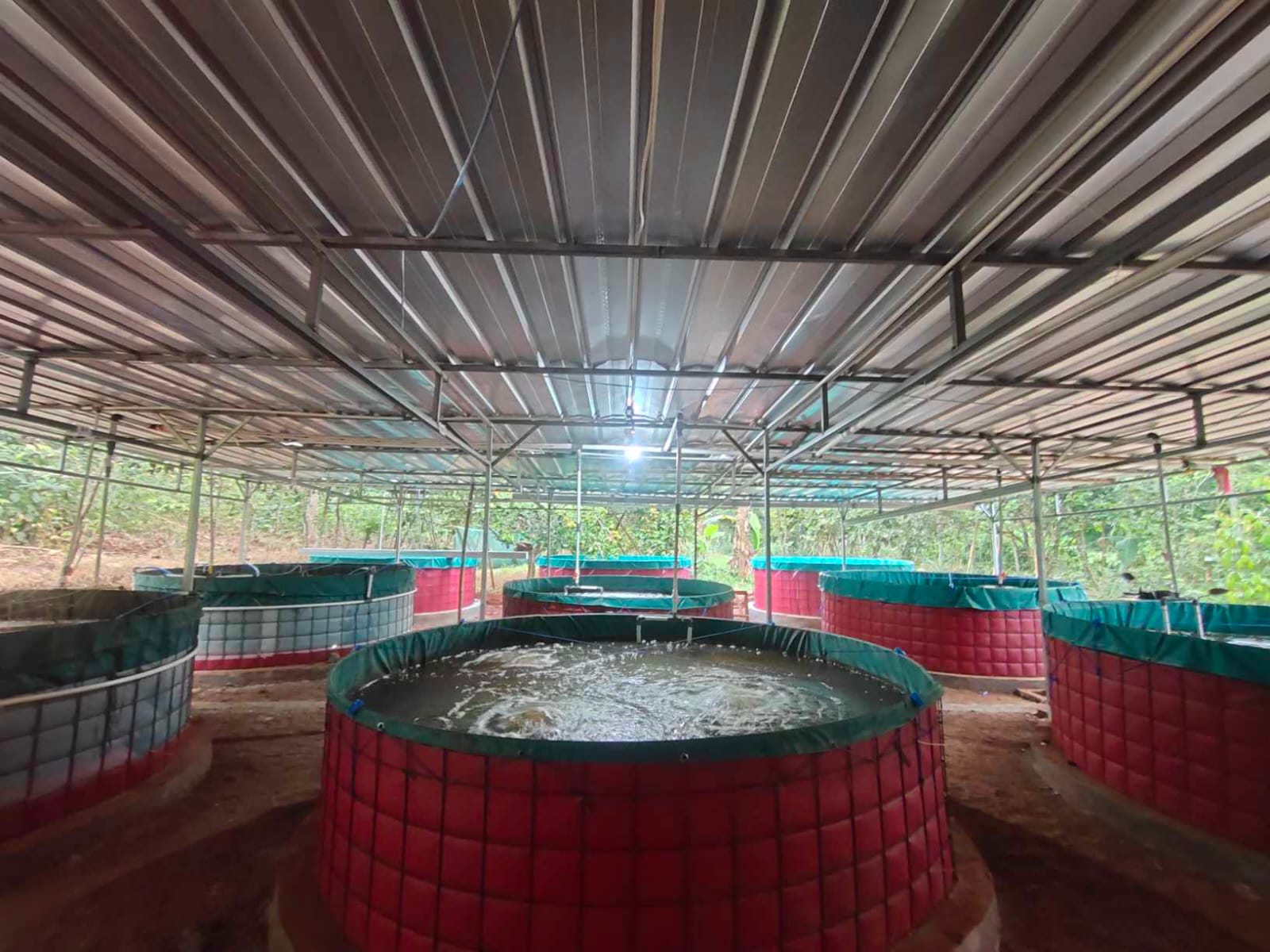
To address these challenges, backyard fish farming (small-scale aquaculture practiced in residential spaces) emerges as an innovative solution. This model enables households to cultivate fish independently using minimal land and investment. Simple systems such as tarpaulin ponds, biofloc technology, or aquaponics can empower communities to produce their own seafood, contribute to national food security, and generate supplementary income. Such initiatives are particularly viable in urban settings, where space constraints preclude large-scale operations, aligning with global trends in urban farming.
Backyard fish farming
Backyard fish farming is a small-scale aquaculture system implemented in limited spaces, such as residential areas, using minimal infrastructure. This concept employs simple technologies like lined ponds, biofloc systems, and aquaponics. In Brunei Darussalam, suitable species for such systems include catfish (Clarias gariepinus), tilapia (Oreochromis niloticus), and pangasius (Pangasius sp.), all of which exhibit rapid growth rates and high economic value.
Biofloc technology has gained popularity in small-scale fish farming due to its resource efficiency. As outlined in Biofloc Technology: A Practical Guide Book by Avnimelech, this system improves feed efficiency by up to 30% compared to conventional methods. Microorganisms in biofloc systems convert organic waste into supplemental nutrients for fish, reducing reliance on external feed inputs. Additionally, the system minimizes water consumption, making it both environmentally sustainable and cost-effective.
Aquaponics combines fish farming with hydroponic plant cultivation, creating a closed-loop, resource-efficient ecosystem. Research published in the International Journal of Bioassays highlights that aquaponic systems can reduce synthetic fertilizer use by 70% while increasing crop productivity by 20% compared to traditional farming. In Brunei Darussalam, where urban agricultural land is scarce but demand for fresh produce remains high, aquaponics presents a viable solution for sustainable food production in residential and peri-urban settings.
Beyond resource efficiency, backyard fish farming supports household food security. According to the Food and Agriculture Organization (FAO), small-scale aquaculture can fulfill up to 60% of a family’s daily protein requirements, particularly in regions with high per capita fish consumption like Brunei Darussalam. By decentralizing food production, this approach empowers households to supplement their diets with nutrient-rich protein sources while reducing dependence on commercial supply chains.
The benefits of backyard fish farming
1. Enhanced aquaculture literacy
Backyard fish farming initiatives can improve public understanding of aquaculture fundamentals, including water quality management, feeding practices, and disease prevention. Such knowledge is vital for advancing Brunei Darussalam’s sustainable fisheries sector. According to a Food and Agriculture Organization (FAO) report, aquaculture education and training programs have been shown to increase fish farming productivity by up to 40% in Southeast Asian nations.
2. Household food security and nutritional resilience
Self-sufficient fish production provides families with a cost-effective, high-quality protein source while reducing reliance on imported seafood. Brunei Darussalam currently imports approximately 60% of its fish supply, highlighting vulnerabilities in food security. Backyard aquaculture systems can mitigate this dependency, ensuring consistent access to fresh, nutrient-rich fish. Regular consumption of omega-3 fatty acids (abundant in freshly farmed fish) supports cardiovascular health, cognitive function, and overall public well-being, aligning with national health objectives.
3. Economic diversification opportunities
Small-scale backyard operations offer households supplemental income through the sale of surplus harvests to local markets or restaurants. Furthermore, these models can evolve into community-driven enterprises, fostering collaborative economic growth. Data from the Asian Development Bank (ADB) reveals that household-based aquaculture schemes in select ASEAN countries have boosted earnings for small-scale farmers by 20–30%. By integrating microenterprise development with sustainable practices, backyard fish farming aligns with broader goals of poverty reduction and rural economic resilience.
Case studies: international applications of backyard fish farming systems
Backyard fish farming models have demonstrated measurable success in multiple countries, offering valuable insights for scalable implementation. In Southeast Asia, Indonesia and Thailand exemplify how household-level aquaculture initiatives can enhance food security and economic resilience.
Indonesia has pioneered the adoption of biofloc technology in small-scale aquaculture, enabling farmers to optimize feed efficiency and production yields. According to research by the Indonesian Ministry of Marine Affairs and Fisheries (KKP), biofloc systems can increase fish survival rates to 90% while reducing feed requirements by 25%. A standout innovation is the Budidaya Ikan dalam Ember (Budikdamber), or "bucket-based fish farming," which gained traction during the COVID-19 pandemic. This low-cost, space-efficient method allows households to cultivate fish and vegetables simultaneously in repurposed containers, fostering food self-reliance during economic disruptions.
Thailand’s approach emphasizes sustainability through aquaponics, a closed-loop system combining aquaculture and hydroponic agriculture. Data from the World Aquaculture Society highlights that Thai aquaponics programs have reduced chemical fertilizer use by 60% and boosted fish yields by 25% compared to conventional farming. By integrating fish waste as nutrient-rich water for crops, this model not only conserves resources but also diversifies income streams for rural and urban communities.
In Brunei Darussalam, early-stage programs such as "Urban Farming" aim to popularize backyard aquaculture in space-constrained environments. While these initiatives show promise, their scalability hinges on enhanced governmental support, including technical training, access to advanced technologies, and public-private-academic partnerships. For instance, integrating smart sensors for water quality monitoring or adopting automated feeding systems could optimize small-scale operations. Furthermore, collaboration with regional experts (drawing on Indonesia’s biofloc expertise or Thailand’s aquaponics frameworks) could accelerate Brunei’s progress in reducing import dependency.

Implementation of bucket-based aquaculture (budikdamber) in limited residential spaces in Bandung City, West Java: Prokopim Kota Bandung
Challenges and solutions in developing backyard fish farming
While backyard fish farming presents a promising avenue for sustainable food production, its implementation in Brunei Darussalam faces several challenges that require targeted solutions. Addressing these barriers is critical to unlocking the full potential of small-scale aquaculture systems.
A primary challenge lies in the limited technical knowledge and practical skills among local communities. Many residents lack familiarity with efficient, sustainable fish farming techniques, leading to suboptimal practices. To bridge this gap, expanding access to training and educational programs is essential. Government-led workshops, collaborations with universities, and partnerships with non-governmental organizations can empower communities with foundational aquaculture skills. According to a FAO study, providing technical training to small-scale fish farmers has been shown to increase productivity by up to 40%, underscoring the importance of capacity-building initiatives.
The relatively high upfront costs of establishing backyard fish farms (including pond construction, purchasing fingerlings, and operational expenses) pose a significant barrier for many households. To mitigate this, financial support mechanisms such as government subsidies, low-interest loans, or grants for small-scale aquaculturists can ease the burden of initial investments. For instance, in countries like Malaysia and Vietnam, state-backed capital assistance programs have boosted the number of household aquaculture ventures by 50% within five years. Similar strategies in Brunei could democratize access to backyard fish farming, particularly for low-income communities.
Brunei’s limited local supply chains for fish fingerlings and feed present another obstacle. Dependence on imported or scarce resources disrupts production consistency and inflates costs. Strengthening domestic supply networks through support for local hatcheries and promoting alternative feed innovations offers a viable solution. For example, insect-based feeds, such as black soldier fly larvae (Hermetia illucens), or agricultural byproducts can reduce reliance on conventional, costly fishmeal. Research published in the Journal of Aquatic Sciences highlights that insect-derived feeds can lower production costs by 30% without compromising harvest quality. Additionally, incentivizing community-based feed production using organic waste streams could enhance affordability and sustainability.
Opportunities for developing aquaculture in Brunei Darussalam
Banglele Indonesia identifies significant potential in advancing Brunei Darussalam’s aquaculture sector, driven by rising public interest in modern fish farming practices and the growing demand for sustainable protein sources. To support this initiative, Banglele Indonesia will participate in the Customer Fair and Trade Expo 2025 at the Wonderful Indonesia Expo (Booth No. 74), alongside other Indonesian enterprises. This event, sponsored by the Indonesian Embassy in Bandar Seri Begawan, aims to showcase Banglele Indonesia’s expertise in aquaculture and present innovative solutions for strengthening Brunei Darussalam’s fisheries sector.

H.E. Prof. Dr. Achmad Ubaedillah, Ambassador Extraordinary and Plenipotentiary of Indonesia to Brunei Darussalam, visited the Banglele Indonesia booth at the Wonderful Indonesia Expo during the Customer Fair and Trade Expo 2025 in International Convention Center (ICC) Berakas, Bandar Seri Begawan, Brunei Darussalam
In pursuit of broader impact, Banglele Indonesia has partnered with Kabunku Aquaponics (kabunku.bn) to drive aquaculture development in Brunei Darussalam. A key focus of this collaboration is establishing a dedicated distribution network for premium Indonesian ornamental fish, with Kabunku Aquaponics serving as a centralized hub for displaying Indonesia’s high-quality aquatic species. This initiative not only simplifies access to ornamental fish for Bruneian consumers but also creates new export opportunities for Indonesian suppliers to penetrate Brunei’s market.
Beyond ornamental fish marketing, the partnership includes comprehensive training programs on modern aquaculture systems. Participants will gain insights into cutting-edge technologies such as biofloc systems, aquaponics, and sustainable fishery waste management. These educational initiatives are designed to enhance the technical capabilities of local fish farmers, accelerating the adoption of efficient and eco-friendly practices to support Brunei’s sustainable aquaculture growth.

Diversity of leafy greens in Kabunku Aquaponics, Brunei Darussalam: kabunku.bn
Banglele Indonesia and Kabunku Aquaponics are committed to implementing a nucleus-plasma (hub-and-spoke) model for export-focused fisheries. Aligned with Brunei Darussalam’s national policy to diversify its economy through non-oil sectors, this model provides local farmers with access to advanced technologies, market linkages, and mentorship. Such support aims to boost production capacity and enhance the global competitiveness of Brunei’s aquaculture products.
The collaboration also encompasses the development of Black Soldier Fly (BSF) larvae as an eco-friendly, protein-rich alternative to conventional fish feed. Additionally, Banglele Indonesia will supply specialized aquaculture equipment and technologies, including probiotics, fish supplements, UV filtration systems, and modular pond installations. These efforts aim to establish a resource-efficient aquaculture ecosystem that bolsters food security, economic resilience, and environmental sustainability in Brunei Darussalam.