Indonesia stands on the global stage as a veritable titan in the seaweed industry, commanding a dominant position particularly for tropical variants such as Eucheuma cottonii the primary biological source of carrageenan and Gracilaria sp., the precursor for agar-agar production. As the archipelagic nation possessing the second-longest coastline in the world, the coastal ecosystems of the Nusantara provide a habitat that is nearly perfect for the proliferation of these macroalgae. Data from the Ministry of Marine Affairs and Fisheries (KKP), alongside various global market observations, unequivocally positions Indonesia as the world’s leading supplier of hydrocolloid raw materials, a critical input for the global food and pharmaceutical sectors.
Yet, behind these massive production statistics and the veneer of market dominance lies a persistent irony often referred to in development economics as the "paradox of abundance.".
Thousands of seaweed farmers along the coasts, stretching from the waters of Takalar in South Sulawesi to the remote shores of Rote Ndao in East Nusa Tenggara, remain trapped in a cycle of subsistence economics. While estimates suggest that over 62,000 households across the archipelago are engaged in seaweed farming, their integration into the global value chain remains precarious. Although they produce a commodity that serves as a vital base ingredient for the global food, pharmaceutical, and cosmetic industries ranging from gelling agents in desserts to stabilizers in toothpaste the exchange value they receive is often disproportionately low.
The root cause of this stagnation in welfare is not a lack of cultivation skills. Indonesian farmers are highly proficient in both long-line and off-bottom cultivation techniques, methods that have been refined over decades of practice. Rather, the bottleneck lies at a critical juncture in the post-harvest phase: the drying process. It is here, in the gap between harvest and sale, that value is lost, and the economic potential of the "Blue Economy" is eroded by the realities of tropical meteorology.

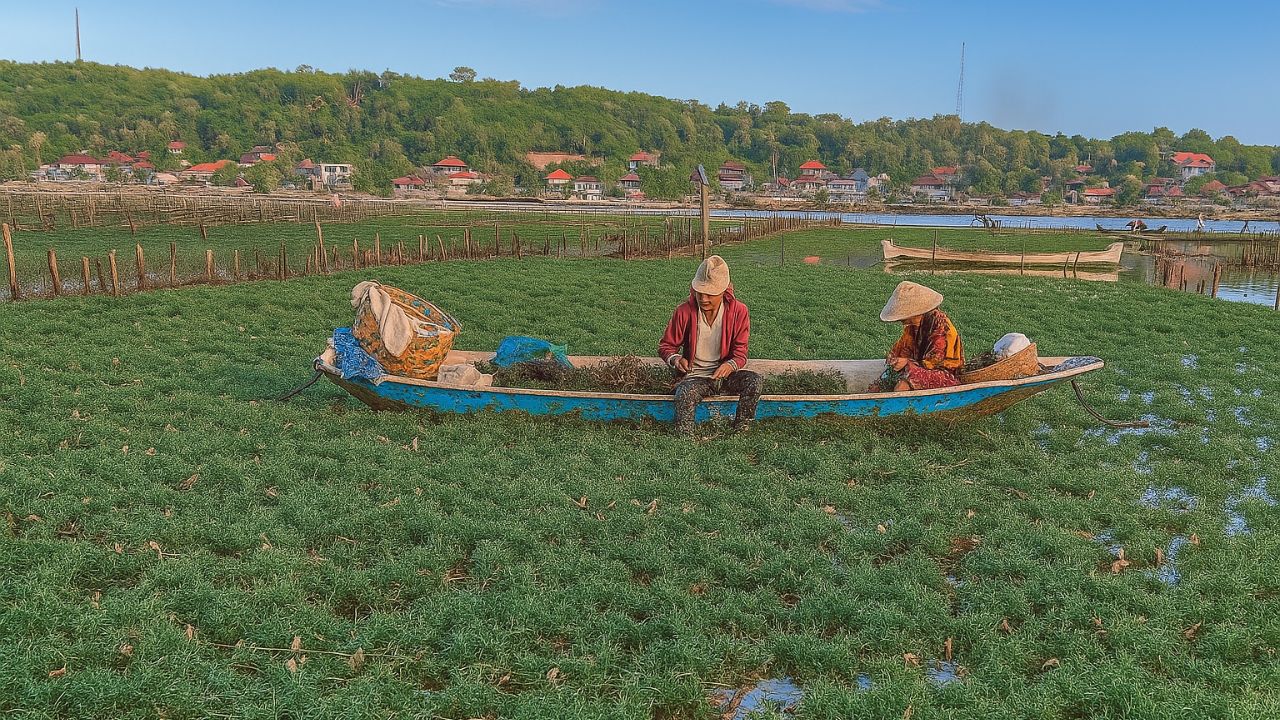
Seaweed cultivation method using off-bottom technology: Banglele Indonesia
Anatomy of the post-harvest crisis; why is the sun alone not enough?
To understand the urgency of the greenhouse dryer innovation, one must first dissect the fundamental weaknesses of the existing traditional practices that have defined the industry for generations. Seaweed drying is, in essence, a complex process of biopolymer preservation, governed by the strict laws of thermodynamics and biochemistry.
The tyranny of relative humidity
Indonesia lies squarely on the equator, a geographic reality that blesses it with biodiversity but curses it with high relative humidity (RH) year-round, often exceeding 80 percent. The traditional method of open sun drying—spreading the harvest on simple mats or asphalt—relies heavily on the Vapor Pressure Deficit (VPD), which is the difference in water vapor pressure between the surface of the seaweed and the surrounding air.
The efficiency of this passive drying method is entirely at the mercy of the weather. On cloudy days or when rain falls, the VPD drops drastically, effectively halting the moisture migration from the seaweed thallus to the atmosphere. Worse still, seaweed is inherently hygroscopic; it loves water. During the night or when it rains, semi-dried seaweed undergoes a phenomenon known as re-humidification. It reabsorbs water vapor from the humid coastal air, triggering a dangerous rise in water activity (aw).
This re-wetting creates a "wet-dry-wet" cycle that not only prolongs the processing time to 5–7 days but also creates a fertile ground for microbial resurgence. The prolonged exposure to moisture and oxygen triggers enzymatic browning, a chemical reaction mediated by polyphenol oxidase, and uncontrolled fermentation. These reactions attack the integrity of the carrageenan polymer chains, degrading the very hydrocolloid properties that buyers seek.
The Clean Anhydrous Weed (CAW) standard
The implications of these traditional methods extend beyond mere drying times to the rigorous quality standards of the international market. One of the most critical parameters for export is the percentage of Clean Anhydrous Weed (CAW).
CAW represents the actual seaweed content after all moisture, salt, sand, and impurities have been chemically and physically removed. International standards typically mandate a CAW of 35 percent or higher, with impurities kept strictly below 3–5 percent.
Drying seaweed in open areas, especially when placed directly on the ground or sand, makes achieving these standards nearly impossible. Wet seaweed thalli, oozing with salt exudates, are sticky traps for foreign particles. Sand, road dust, and increasingly, microplastics, adhere to the surface, becoming embedded in the drying tissue. This contamination significantly lowers the CAW percentage, forcing collectors to downgrade the product or reject it entirely.
Biological and chemical degradation
Beyond physical contaminants, unprotected drying increases the risk of biological contamination. The open-air approach leaves the harvest vulnerable to bird droppings and rodents, which can introduce pathogens like Salmonella or E. coli. For international buyers enforcing strict Food Grade standards, such biological contamination is non-negotiable grounds for rejection.
Furthermore, the sun itself is a double-edged sword. While its heat is necessary for drying, its ultraviolet (UV) radiation can be destructive. Prolonged exposure to UV-B and UV-C rays directly damages the chemical bonds in the seaweed's pigments (causing bleaching) and scissions the polysaccharide chains. This molecular degradation manifests as reduced gel strength (measured in g/cm²) and viscosity, rendering the carrageenan less effective for industrial applications.
Design and working principles of the greenhouse dryer
The greenhouse dryer innovation represents an engineering response to these environmental and biological challenges. It is not merely a shelter; it is a machine that manipulates thermodynamic variables temperature, humidity, and airflow within a closed system to create optimal drying conditions independent of external weather fluctuations.
Structural specifications
Based on the implementation of standards at pilot locations such as the Smart Fisheries Village (SFV) Wanamina Marana in Maros, managed by the KKP, the seaweed dryer unit is designed with technical specifications strictly focused on durability in saline environments and thermal efficiency.
The structure typically measures approximately 4 meters (13.1 feet) in length, 3 meters (9.8 feet) in width, and 2.5 meters (8.2 feet) in height. These dimensions are calculated to accommodate a carrying capacity of between 400 and 500 kilograms (881 to 1,102 pounds) of wet seaweed per cycle, making it an appropriate scale for small-to-medium cultivator groups (Pokdakan).
Table 1: Technical specifications of the greenhouse dryer unit

The framework is constructed using galvanized hollow iron. In the corrosive atmosphere of a coastal village, standard steel would rust rapidly. Galvanization, a zinc coating process, provides a sacrificial anode that protects the structural integrity of the dryer against the salt-laden sea breeze. The walls and roof are clad in mica plastic or polycarbonate sheets that have been chemically stabilized to resist UV degradation. This material selection is critical; it must be transparent enough to admit solar radiation but opaque to the long-wave infrared radiation emitted by the heated interior, thereby trapping heat via the greenhouse effect.
Airflow and configuration
To ensure the system does not become a steam bath, the unit is equipped with exhaust fans installed at strategic positions, typically on the upper rear wall where hot, moist air naturally accumulates. These fans can be powered by the standard PLN grid or, in off-grid locations, by solar photovoltaic panels.
Inside, the seaweed is not piled on the floor. It is arranged on tiered racks or suspended from hangers. This configuration is deliberate, maximizing the surface area exposed to the warm, dry air and ensuring that airflow is turbulent and evenly distributed across every thallus. The floor itself is often coated in a dark color or left as bare concrete to act as a thermal mass, absorbing solar energy during the day and radiating it back as heat.
Mechanism of the greenhouse effect
The working mechanism of this drying tool relies on the precise management of thermal energy. It is a passive solar collector augmented by active ventilation.
Thermal trapping
Solar radiation (short-wave) penetrates the transparent roof and strikes the seaweed and the dark internal surfaces. This energy is absorbed and re-radiated as heat (long-wave infrared radiation). The mica plastic cladding is largely impermeable to this long-wave radiation, trapping it inside the structure.
In optimal conditions, the internal temperature of the dryer can reach 55–60 degrees Celsius (131–140 degrees Fahrenheit). This represents a thermal gain of approximately 15–25 degrees Celsius (27–45 degrees Fahrenheit) over the ambient outdoor temperature.
Humidity control
This elevation in temperature has a profound thermodynamic effect: it lowers the relative humidity of the air inside the chamber. As air warms, its capacity to hold water vapor increases exponentially. This warm, "thirsty" air pulls moisture rapidly from the seaweed cells.
However, this process is self-limiting without ventilation. As the air absorbs moisture, it becomes saturated, and drying stops. This is where the exhaust fan becomes the heart of the system. By continuously expelling the moisture-laden air and replacing it with fresher (albeit cooler) air from outside, the fan maintains a high Vapor Pressure Deficit, driving the drying process forward even when external humidity is high.
Hybrid capabilities
To overcome the intermittency of the sun, engineers have developed hybrid solar dryer variants. These systems integrate auxiliary heat sources to ensure drying continues through the night or during monsoon rains.
- Biomass Furnaces: Some units utilize simple stoves fired by agricultural waste (coconut husks, dried stalks), injecting hot air into the chamber.
- Electric Heaters: Where electricity is reliable, resistive heating elements provide precise temperature control.
In advanced deployments, such as those in the Smart Fisheries Villages, the system is automated. Microcontroller-based sensors monitor internal temperature and humidity, toggling fans and heaters to maintain the ideal psychrometric conditions for carrageenan preservation without constant human supervision.
Advantages of greenhouse and hybrid dryer technology
The transition from open sun drying to greenhouse technology offers transformative benefits that have been validated through field studies and the practical experience of farmers in the SFV program.
Accelerated drying and capital turnover
Time is the most immediate currency for the farmer. In the traditional method, drying is a test of patience, taking 3–5 days in clear weather and stretching to over a week during the rainy season. The greenhouse hybrid dryer slashes this timeline dramatically. It can reduce the moisture content to the safe standard of 12–15 percent in just 16–24 hours of continuous operation.
This efficiency creates a velocity of capital previously unknown in coastal villages. Instead of waiting a week to sell their harvest, farmers can process a batch every day.
Production capacity explosion
The reduction in drying time translates directly into increased throughput. With a daily turnover cycle, a single 500 kg unit can process up to 15 metric tons (16.5 short tons) of wet seaweed per month. This represents a capacity increase of up to 300 percent compared to traditional methods. For a cooperative or Pokdakan, this volume allows them to aggregate sufficient quantities to negotiate directly with industry processors, bypassing low-level middlemen.

Greenhouse system-based seaweed dryer technology: Humas Kementerian KP
Quality assurance
By isolating the seaweed from the environment, the greenhouse dryer guarantees a cleaner product. The exclusion of sand, dust, and animals ensures high CAW values and compliance with food-grade safety standards. Furthermore, the protection from direct UV radiation preserves the pigment and the polymer chain length, resulting in higher gel strength and a more valuable product for the extraction industry.
Downstreaming strategy and national policy integration
The adoption of greenhouse dryer technology is not an isolated technical upgrade; it is a foundational component of Indonesia's grand strategy for maritime economic development, known as the Blue Economy Roadmap.
The Smart Fisheries Village (SFV) initiative
The Ministry of Marine Affairs and Fisheries (KKP), under the leadership of Minister Sakti Wahyu Trenggono, has institutionalized these innovations through the Smart Fisheries Village (SFV) program. The SFV concept is not merely about equipment; it is an integrated approach to rural development that combines technological adoption, digital management, and community empowerment.
The SFV Wanamina Marana in Maros, South Sulawesi, serves as the national pilot for this technology. Here, the greenhouse dryer developed by the Loka Riset Mekanisasi Pengolahan Hasil Perikanan (LRMPHP) was first proven effective. Following this success, the model has been replicated in other strategic production centers:
- Takalar, South Sulawesi: A traditional powerhouse of seaweed farming.
- Wakatobi, Southeast Sulawesi: A region designated for high-value aquaculture modeling.
- Nunukan, North Kalimantan: A border region where product quality is essential for competing with neighboring international markets.
Driving "Hilirisasi" (downstreaming)
The ultimate goal of these technological interventions is to support the national mandate for hilirisasi or downstreaming. President Prabowo and the KKP have explicitly directed a shift away from exporting raw dried seaweed. The vision is to process seaweed domestically into high-value derivatives such as pure carrageenan, agar strips, biostimulants, and biodegradable plastics.
However, industrial processing requires industrial-grade raw materials. Factories cannot operate efficiently with dirty, wet, or inconsistent seaweed. The greenhouse dryer bridges this gap. It ensures that the feedstock entering the factory meets the rigorous specifications for moisture and purity required for efficient extraction.
To further cement this ecosystem, the government is investing in supportive infrastructure, including cold storage facilities and modern drying centers in industrial zones like Karawang and key hubs in Eastern Indonesia. These facilities act as buffers, absorbing the increased production from farmers, stabilizing prices, and ensuring a steady flow of high-quality raw material to the domestic processing industry.
In conclusion, the humble greenhouse dryer, a structure of galvanized iron and plastic stands as a linchpin in Indonesia's maritime ambitions. It solves the "paradox of abundance" by converting a raw, vulnerable harvest into a stable, high-value commodity, thereby lifting coastal communities out of subsistence and anchoring the nation's Blue Economy future.